Thursday, 31 March 2016

Moo Hong (Stewed Pork)


I've been looking forward to making this sticky, sweet braised pork dish for a while now and it did not disappoint. Moo Hong belongs to a family of similar Chinese influenced, dark coloured stews that also includes khao kha moo (stewed pork leg) and moo paloe (pork braised with eggs). They all share some common ingredients: soy sauce, star anise, long cooking time and fatty cuts of pork but it's down to the consistency and what they're served with that makes for some subtle differences.

Moo Hong uses large chunks of belly pork and is cooked down until you're left with a rich, peppery, sweet and sticky sauce and meat that is soft and unctuous. Although it needs just over an hour to cook it's very easy to make.


For two large portions use:


  • 400g of pork belly, rind removed and cut into inch square pieces. Try to find a piece that is fairly even in thickness and has a good meat/fat ratio
  • half a bulb garlic, peeled
  • a dessert spoon of black peppercorns
  • a small handful of coriander roots or stalks (roots seem impossible to find in the UK)
  • a golf ball size chunk of palm (or light brown) sugar
  • 3 star anise
  • a big splash of oyster sauce
  • a big splash of light soy sauce
  • a big splash of dark sweet soy sauce (I use Indonesian kecap manis)
  • 2-3 cups of water (you may need a bit more)
  • small splash of oil for frying

Make a well blended paste by bashing the black pepper, palm sugar, garlic and coriander in a mortar; by adding the harder ingredients first and adding the softer ones last you should end up with a fairly smooth paste.

Heat a splash of vegetable oil in a deep pan until medium hot. Carefully add in the cubed pork belly and fry for 3-4 minutes until some of the fat has rendered out and the pork is lightly browned. Pour off the excess fat from the pan (there'll be plenty in the dish as the pork cooks down).

Pop in the spice paste and stir well for a moment or two; the sugar in the paste will make the pork sticky but be careful not to let it sit and burn. 

Pour hot water over to just cover the pork then add in the rest of the ingredients (sauces and star anise). The sauce will be dark but very thin. Pop on a lid and lower the heat to a gentle simmer, let the pork reduce and cook down for around 75-90 minutes. Check it and stir gently every now and again, making sure there's still enough liquid; top up with a little water if need be.

The final sauce should be thick and sticky (of a honey- like consistency). Serve with freshly cooked rice and some extra coriander.

Saturday, 26 March 2016

Gaeng Som Cha Om (Sour Curry with Acacia Omelette)


Gaeng Som must be one of the few 'curries' I've yet to touch on; my preference for Northern and Central Thai cuisine means I often overlook dishes from South Thailand, perhaps unfairly. To this end today's recipe and the next will focus on southern Thai food.

Gaeng Som is more soup like than other curries and has a simple and aromatic paste making it an easy dish to pull off. It's sourness comes from a combination of tamarind paste and lime juice. Any combination of crunchy vegetables can feature in a gaeng som but keeping it traditional, I've just used bamboo shoots. A popular addition; acacia omelette (kai jeow cha om) helps to provide a pleasing textural contrast and soaks up some of the broth.

For 4 small bowls use:

  • 200g peeled prawns
  • 200g of drained and rinsed bamboo shoots, sliced
  • 50ml of taramind concentrate
  • juice of 1 lime
  • small handful of peeled Thai shallots
  • small handful of dried red chillies
  • 4 or 5 fingers of krachai (galingale) chopped
  • 1 teaspoon of shrimp paste
  • 2 cups of chicken or vegetable stock
  • a big splash of fish sauce

and for the accompanying acacia omelette follow this recipe

Begin by making the acacia (cha om) omelette, cutting it into squares and keeping warm while you make the curry.
Make the curry paste by pounding the dried red chillies, shallots, shrimp paste and krachai in a mortar, working it until you have a well blended red paste. The krachai will be one of the predominant flavours of the dish whilst the chillies give it it's orangey/red colour.
Boil the chicken stock in a large pan and pop in all the prepared paste, mixing well. Turn down the heat to a simmer.
Add in the bamboo shoots and cook for 2 minutes, then add in the tamarind and fish sauces.
Next in go the prawns- 3 minutes or so for raw, 1-2 for pre-cooked.
Finally squeeze in the lime juice, give everything a final quick stir and stir with freshly cooked rice.
Serve the acacia omelette both in and on the side of your gaeng som.


Monday, 21 March 2016

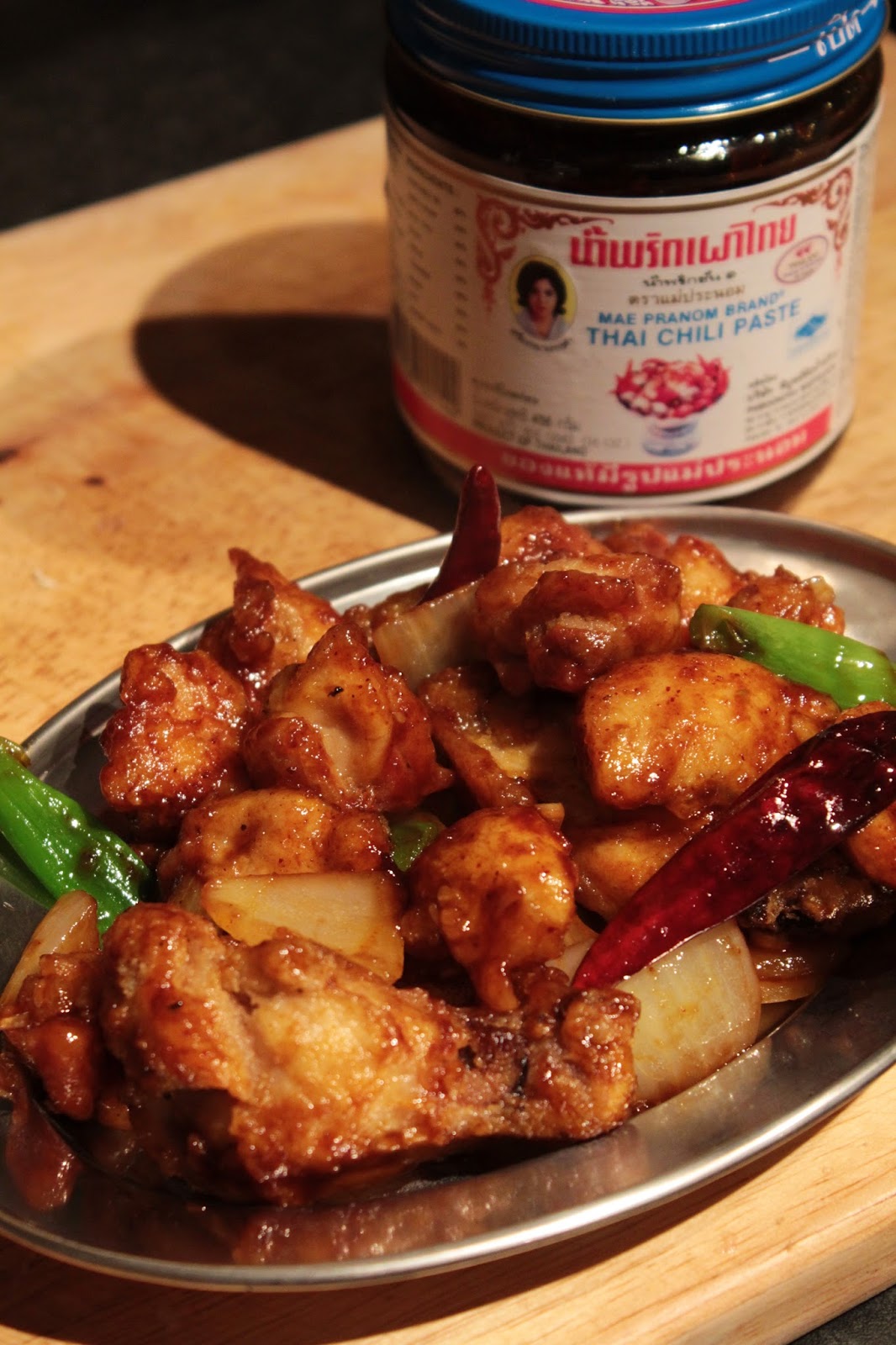
Gai Tod Pad Nam Prik Pao (Fried Chicken Stir Fried with Roasted Chilli Paste)


It's very rare these days that we would ever buy a takeaway, I've just had way too many identical oil drenched, msg ridden, jam-like, tummy ache laden meals to ever optionally order one then pay through the nose for the privileged. however that's not to say I eat healthy all the time. Like most, I occasionally like deep fried food, I just like my salt, sugar and fat in reasonable amounts and I think takeaway places (by and large) rely on pre made cheap fixes.

Ranting over, when I do want something takeaway like, I'd much rather make it myself, lets face it, as long as you have the ingredients in, you can be eating this quicker than it would take for a takeaway to be delivered. I guarantee this crunchy, spicy, sticky stir fry will satisfy all your takeaway urges!! It differs quite substantially from all the other English written versions of gai tod nam prik pao, this is taken directly from a Thai recipe and is the real thing!

As an added bonus, it's a 2 in 1 dish. If you just want the chicken as a starter/snack, use wings and forgo the vegetables. If it's a whole meal, keep the veggies in and serve with rice.

For the stir fry version for two people use all the ingredients:
For the chicken wing snack version use just the ingredients with a * next to them
  • 4 large chicken thigh fillets, skinned and cut into large cubes or 10 wings, jointed*
  • 1 large onion, peeled and cut into large chunks
  • 2 spring onions, kept in large chunks
  • 4 cloves garlic, peeled and finely chopped
  • a small handful of dried red chillies
  • a heaped dessert spoon of roasted chilli paste (nam prik pao)*
  • a big splash of light soy sauce*
  • a big splash of oyster sauce*
  • a big pinch of brown or palm sugar*
  • rice flour for dredging the chicken (plain flour is ok too, just not as light and crispy as rice)*
  • salt and pepper*
  • oil for deep frying and splash for stir frying*

Season the chicken with salt and pepper, then dredge it through the rice flour, shake off the excess.
Heat a deep fat fryer to 190 degree Celsius or use a heavy pan and watch it carefully.
Pop in the chicken pieces and cook until deep golden and crispy (3-5 mins). Drain on kitchen paper.

Heat a small splash of oil in a wok until hot then throw in the onions and stir fry on a high heat to get some colour. Throw in the dried chillies and garlic and stir fry for a few minutes. Throw in the spring onions and the drained fried chicken.

Add in the roasted chilli paste, coating the chicken well, then the remaining sauces and sugar. Everything should be nice and sticky.

* If you make the wings snack version make the sauce in a wok- heat a small splash of oil before adding the roasted chilli paste, sugar oyster sauce and soy sauce, blend well and put the fried chicken wings in, stirring well so everything is coated.


Friday, 18 March 2016

Pak Mara Pad Kai (Bitter Melon Stir Fried with Egg)


There comes a time when occasionally I have to admit defeat with one of my recipes, when I quite frankly hate it. This is one of those times. Bitter melon is most definitely not for me- although it's supposed to be very healthy for you and I purposely chose the palest ones the market stall had, it still tasted like something that shouldn't be eaten!! My palate just isn't accustomed to bitter as a predominant flavour. 

If you would like to try the health giving properties of pad pak mara kai, here's the recipe...

  • 2 small bitter melons (paler are less bitter supposedly) cut in half lengthways and seeds scooped out, cut into thin slices.
  • 2 eggs, beaten
  • a big pinch of ground black pepper
  • a small splash of light soy sauce
  • a small splash of fish sauce (or a bit extra soy if you're vegetarian)
  • a splash of vegetable oil for stir frying

Heat a wok with the oil until hot. Throw in the bitter melon and stir fry for a couple of minutes until beginning to soften. Push to one side and pour in the beaten egg. Let it set for a moment before scrambling and then mixing all together again. Add in the sauces and pepper and mix well, frying for a couple more minutes before serving.

Tuesday, 1 March 2016

Pla Tod Khamin (Turmeric Fried Fish)


Ahh, poor bonito; fish never look quite so pretty when they've been deep fried whole- I'm not one for removing heads though, I'd much rather keep them whole- plus you'd miss out on the cheeks!

Saturday just gone I did one of my favourite things to do in my free time, wandering round food markets, picking up random things to take home and make things with. I went to Bolton market; I've been there once before and remembered it was a great place to pick up every kind of fish, cut of meat, exotic vegetables and great for local northern produce. It also has a great fresh Thai fruit and vegetable stall, easily on par with any of my usual favourites in Leeds, Manchester and Birkenhead- very reasonable prices too. 

Along with my bonito fish (£5 for a huge fish), some acacia (cha om), fresh green peppercorns (just because I struggle to get them) I also picked up some bitter gourds for a recipe which will follow soon.

There is nothing fancy about the fish- I wanted to cook it in a way that would do it justice, quickly and simply and served it with nam prik seafood (seafood sauce) and some rice. We ate it as you see it here, sharing it between us.

For two people use:

  • a large meaty fish, gutted, scaled and deep slashed cut into both sides
  • several knobbly pieces of fresh turmeric, chopped
  • half a bulb of garlic, peeled and chopped
  • a lot of vegetable oil for deep frying
and if you fancy making the 'sauce seafood' to go with it- here's the link within another of my earlier recipes... 

Heat a large, deep wok full of vegetable oil until hot. Very, VERY carefully slowly slide the fish in and allow it to develop a deep golden crispiness- it will need to be carefully turned over half way through the cooking. It will depend on size but mine took about 10 minutes.

Gently lift out, use two spatulas (an extra pair of hands helps) and drain on kitchen paper.

Still in the hot oil, drop in all the chopped turmeric and garlic and deep fry for around 2 minutes- stirring regularly until you can see the garlic is a light golden brown and everything is slightly crispy. Scoop out with a sifter and sprinkle over the fish.


Thursday, 25 February 2016

Pad Kee Mao Moo (Drunk's Noodles with Pork)


I'm spending quite a bit of time at the moment re-visiting some of my earlier recipes, making some amendments where needed and updating the photos- some of my earlier attempts were not very pretty!! Pad Mee Mao (Drunk's noodles; so named as they're just right after a night's drinking- think spicy, greasy and quick to make- sooo much better than a nasty takeaway kebab!) hold a special place in my heart; it's the meal I had in Manchester's China town whilst on my hen do back in 2009 and I made a point then of learning the recipe.

There are a couple of changes to the other version of this recipe I made back in 2014- simply I've changed a few of the veggies and I now use the (optional) additions of green peppercorns and krachai (fingerroot) for added punchiness. I also think it's essential that you try to get fresh wide rice noodles (sen yai) for this dish- they're soft and stretchy but not chewy and suck up all the sauce, giving you a relatively dry dish. I've used pork rather than chicken but that's totally up to you, this is a very good candidate for a purely veggie version.

For 4 small/ 3 large portions use:

  • 2 pork steaks, trimmed of fat, cut into thin slices
  • 400g or thereabouts of fresh rice noodles, separated into individual strands
  • a handful of green beans, cut into inch long pieces
  • a carrot, peeled and sliced- I have a fancy gadget- a komkom that does the star shaped edges
  • 6-8 baby corn cobs, sliced into inch long pieces
  • a large bunch of sweet basil or holy basil, leaves ripped off stems
  • (optional) a tablespoon of green peppercorns
  • (optional) a few fingers of krachai (fingeroot), cut into thin slivers
  • 4 large cloves of garlic, peeled
  • 4 small red chillies
  • a very big splash of oyster sauce
  • a big splash of light soy sauce
  • a small splash of fish sauce
  • a small splash of dark soy sauce
  • a pinch of sugar
  • vegetable oil for frying

  • Lightly bash the garlic and red chillies into a rough paste
  • Heat a splash of oil in a wok until hot and very briefly fry the garlic/chilli paste
  • Throw in the pork (if using) and stir fry for a minute
  • Throw in the veggies and stir fry, tossing everything together
  • If using, throw in the green peppercorns and krachai and mix, cooking for 2 minutes
  • Put all the sauces and sugar in together, stir the ingredients through.
  • Put in all the noodles, mixing very well so they absorb the sauces and colour. Careful not to overcook- rice noodles can become stodgy very quickly- only cook as long as needed, around 1 minute.
  • Toss through the sweet basil leaves, sprinkling some over the top of the finished dish.


Saturday, 20 February 2016

Guay Tiew Nam Moo (Pork Noodle Soup)


There's nothing quite like slurping down a bowl of well seasoned noodles in a savoury broth and guay tiew nam (rice noodle soups) are perfect for that. They can be more or less whatever you want them to be using any kind of combinations of ingredients and seasonings. They are both hearty and filling but very healthy too, just right for a cold February evening. You'll find noodle soup sellers up and down Thailand on any available street corner working from restaurants, stalls and push carts and they're one of the easiest and most popular dishes to grab on the go.

For two big bowls use:

  • a small pack of fresh rice noodles (around 200g) (or 2 leaves of dried- prepared to pack instructions), loosened and separated into individual strands
  • 2 handfuls of beansprouts
  • 2 spring onions, finely sliced
  • 200g pork mince
  • 1 litre water
  • 2 handfuls of chicken bones, raw or cooked, meat on or off. I used chicken wing tips and will save the wings for another recipe.
  • half a bulb of garlic, 1 clove finely chopped, the rest just cut in half
  • a handful of coriander- half finely chopped, half just very roughly cut
  • a tablespoon of black pepper
  • a small splash of fish sauce
And for seasonings, choose from: chilli flakes, sugar, sliced chillies & garlic in vinegar or in fish sauce, lime wedges, peanuts, shredded coriander- it's your choice!


Place the broth ingredients: water, chicken bones, the roughly cut garlic and coriander and 3/4 of the black pepper in a large pan. Bring to the boil and simmer slowly for at least an hour for the flavour to develop.

While the broth cooks make the pork balls; mix mince, finely chopped garlic and coriander, the last 1/4 tablespoon of pepper and the fish sauce together in a bowl. Using your hands, form them into golf ball sized meatballs and leave to one side.

When the broth is ready, use a small sieve or strainer to scoop out and discard all the solids. Turn up the heat and drop in the rice noodles, not for long, around 20 seconds, much longer and they'll turn to mush. Scoop out and place in bowls along with a little broth so they don't clump together.

Into the simmering broth, gently place the pork balls which will cook quickly; around 3 minutes- cut one if half to check if need be. Scoop them out when cooked and place onto of the noodles.

Finally, put in the beansprouts and blanch for no more than 20 seconds so they don't lose their crunch. strain and place in the serving bowl before ladling  over a decent amount of broth to fill the bowl.

Sprinkle over the chopped spring onions and whatever seasoning you like. Feel free to slurp, it's good manners!!


Tuesday, 16 February 2016

Nasi Goreng Kampung (Malaysian Fried Rice- Village Style)


I mentioned a while back that I may from time to time, post a non Thai recipe so hope it's okay that today I'm making a short hop over the border into Malaysia. Some of you may remember I went on holiday for a few weeks last year to Kuala Lumpur and Langkawi where I spent as much time as possible eating my way through dishes from all the cultures that call Malaysia home. 

My husband and I particularly enjoyed the simple rice dishes that we ate for breakfast, such as nasi lemak and this one; nasi goreng kampung (village style fried rice). Although it looks quite a straightforward dish it's full of very strong flavours; notably salty, fishy and spicy ones. Treat yourself and top your portion off with a freshly cooked crisp fried egg.

For 4 large portions use:

  • A large bowl of cold, pre cooked rice
  • a large bunch of morning glory (water spinach) cut into 2 inch pieces
  • a handful of green beans, cut into small pieces
  • 2 large handfuls of dried crispy anchovies (1 handful finely chopped, 1 left whole)
  • 4 red chillies, finely chopped
  • 4 cloves garlic, finely chopped
  • 2 large eggs, beaten
  • 1 small onion, finely sliced
  • a big glug of light soy sauce
  • a big squeeze of kecap manis (sweet, dark, thick soy sauce)
  • vegetable oil for frying

In a deep wok, heat the oil until hot and fry the onion, garlic and chillies until they have some colour (about 2 minutes). 
Stir fry in the handful of chopped anchovies and green beans (open a window/put on the extractor!), frying for a minute before moving the ingredients to the side of the wok and pouring in the beaten egg. 
Let the egg begin to set before lightly scrambling. Let it set again, scramble, set, scramble until fully cooked and mix all the ingredients back together. 
Throw in the morning glory, briefly stir frying for a minute before carefully tipping all the rice in.
Pour over the sauces and gently toss and mix all the ingredients, making sure all the rice is well coated and heated through. 
Have a taste to see if it needs any more sauce and plate up, sprinkling the other handful of dried fish over the steaming rice.


Thursday, 11 February 2016

Gai Khua Kem (Salty Roast Chicken)


I've been making this for years now and had affectionately named it 'stinky chicken' due to the huge amount of garlic and chillies I use in it but only recently did I discover it is actually made in Thailand and even has a name; Gai Khua Kem (Salted Roast Chicken).

I eat this as a guilty pleasure usually over pork ribs or just with chicken wings but this version can best be described as a form of a 'hash', I guess. Anyway, it's a great way to use up a roast chicken.


For 4 small or 2 large portions, use:


  • A roast chicken (or part of)- I had used the breasts for another recipe so mine was mostly comprised of leg, crispy skin, wings and some spare bits from underneath! I chopped the roasted chicken into varying size bits, keeping some on the bone. This allows for a range of textures in the final dish.
  • A whole bulb of garlic, peeled and finely chopped
  • 3-5 hot Thai chillies, or more if you wish
  • 4 spring onions, finely sliced
  • A small splash of oyster sauce
  • A small splash of light soy sauce
  • A big pinch of salt
  • A teaspoonful of ground black pepper
  • A large splash of vegetable oil for frying

Heat the oil in the wok to a low/medium temperature. Add in all the chopped garlic and gently fry, stirring from time to time for 3-5 minutes over a fairly low temp until the garlic is a light brown and crispy. Scoop out and drain on kitchen paper, leave the garlic oil in the wok.

Turn up the heat on the garlicky oil and pop in the chopped chicken, Toss the chicken every now and then to allow crispy bits to develop. Fry for around 5 minutes so the chicken has time to get some colour and crisp.

Throw in the salt and pepper and mix well. Pour in the oyster and soy sauces and stir. Cook until the liquid has evaporated and the sauces have coated the meat well (about 2 minutes).

Next fling in the chillies, stir, then the crispy garlic, stir again and lastly, the spring onion.

Serve with some fluffy white rice.


Saturday, 30 January 2016

Gaeng Pa Moo (Pork Jungle Curry)


Like any recipe, over time you make amendments and adaptations, you find better ways to make a dish or variety of ingredients that have a better 'fit' and are truer to the authentic version of a dish.

This is one such recipe- way, way back in June 2014, jungle curry was one of the first recipes I put up on my blog- click here for beef jungle curry. However, despite being my favourite type of Thai curry, it was always one I felt I couldn't quite do justice to and wasn't as good as I wanted it to be. Over the last couple of years I've been fiddling with both the way the curry is cooked and the ingredients. 

Jungle curry, is a northern Thai curry, heavy on the vegetables, typically one of the hotter Thai curries and is made without coconut milk. If you like spicy hot, herbal flavours with lots of crunchy textures, you'll love Gaeng Pa. It's very easy to do. It's also easily adaptable to be a vegetarian dish- just add more of the meaty king oyster mushrooms and substitute the fish sauce for a big pinch of salt.

So may I present the upgraded- Gaeng Pa Moo (Pork jungle curry)...

This make four portions:

  • 300g of lean pork, sliced thinly
  • 5 baby corn cobs, cut into chunks
  • a small handful of green beans, cut into chunks
  • a large handful bamboo shoots, drained and rinsed
  • 2 king oyster mushrooms, cut into wedges
  • a large handful of pea aubergines/eggplants
  • a large red chilli, sliced
  • 3 fingers of krachai (finger root), finely shredded
  • a tablespoon of green peppercorns
  • a handful of holy basil (or sweet basil- but NOT Mediterranean basil!!)
  • a few kaffir lime leaves, ripped into small pieces
  • a large tablespoon of red curry paste (I use Mae Ploy brand)
  • 300ml of meat stock
  • a small splash of fish sauce
  • a small pinch of palm sugar (or light brown sugar)

  • Heat the stock in a pan (no wok needed for this recipe) until simmering. Add in the pork; it's thinly sliced so will cook quickly, in around 2 minutes. 
  • Add in the red curry paste and stir until thoroughly mixed into the stock. 
  • Add in the lime leaves and krachai strips, which will start to infuse into the broth. 
  • Next pop in the chunkier vegetables; green beans, pea aubergines, baby corn cobs and bamboo shoots, let them cook down for a few minutes then add in the king oyster mushrooms, green peppercorns, sugar and fish sauce. 
  • Cook for a few more minutes, stirring every so often; the vegetables should still retain some crunch. 
  • Just before serving, stir in the basil and chilli slices and serve with rice.