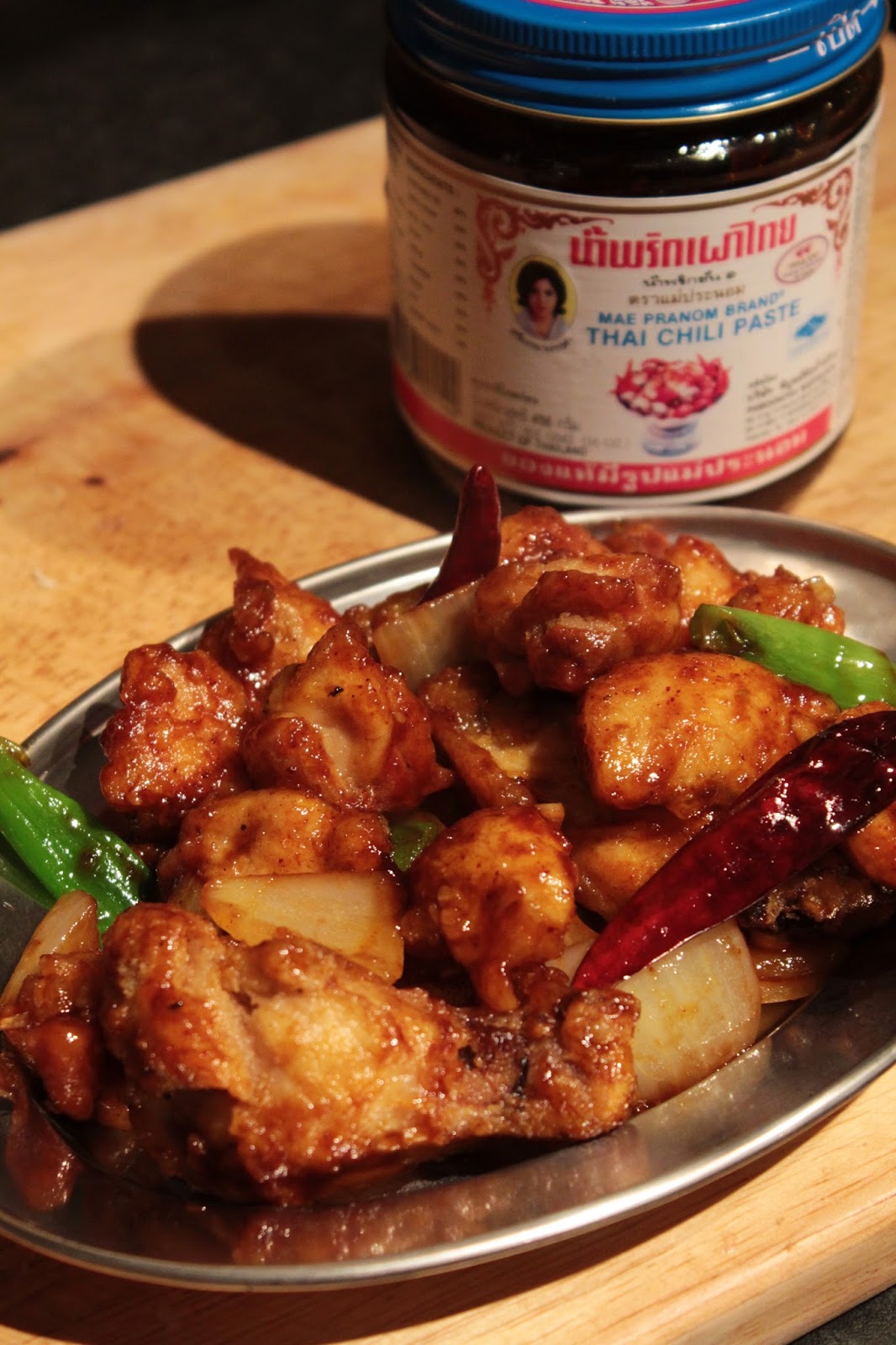
- 4 large chicken thigh fillets, skinned and cut into large cubes or 10 wings, jointed*
- 1 large onion, peeled and cut into large chunks
- 2 spring onions, kept in large chunks
- 4 cloves garlic, peeled and finely chopped
- a small handful of dried red chillies
- a heaped dessert spoon of roasted chilli paste (nam prik pao)*
- a big splash of light soy sauce*
- a big splash of oyster sauce*
- a big pinch of brown or palm sugar*
- rice flour for dredging the chicken (plain flour is ok too, just not as light and crispy as rice)*
- salt and pepper*
- oil for deep frying and splash for stir frying*
Monday, 21 March 2016
Gai Tod Pad Nam Prik Pao (Fried Chicken Stir Fried with Roasted Chilli Paste)
Sunday, 10 May 2015
Khreuang Puang (Thai Condiment Caddy)
Sorry, I’ve been quiet on the blog this week; I’ve not been very well following the typhoid vaccine for our up and coming Malaysia holiday and what with our house now on the market and people coming to view it, it’s been a difficult week to get in the kitchen and get some new recipes out. Following on from the staple Thai store cupboard ingredients post the other week, I thought I’d do a post about the Thai condiment caddy- the ubiquitous 4 pots of seasonings that can be found at every Thai table- whether a restaurant, casual street cafe or a Thai home. I hear that many Thai restaurants in the US will have these too although to date the only one I’ve come across in the UK to have a caddy is Siam Smiles in Manchester which I wrote about a month or two back here.
Often in the west, if we eat at a restaurant it can be seen as poor etiquette to receive a meal, only to start heaping salt/pepper on top of it. Not so in Thailand where it is expected that each diner will want to adapt the flavour of their dish to their personal tastes. The aim is to find your perfect balance of spicy, sour, salty and sweet (known as the 4 flavours). Noodle dishes in particular are most commonly ‘improved’ by additions from the condiment caddy. There are numerous options of sauces, flavourings and ingredients that might be found at a Thai table but here, I have settled here for the 4 that are commonly used (and eaten) by us at home.
In my caddy I have:
- white sugar (naam tam sai)
- chilli flakes (prik bon)
- roasted chilli paste (naam prik pao)
- sliced chillies & garlic in fish sauce and vinegar (naam pla prik gratiem)
Friday, 1 May 2015
Makua Yao Nam Prik Pao (Aubergine with roasted chilli paste)
Despite being in house selling mode and what I said in my last post about not wanting to cook strong smelling food, I couldn’t resist another Thai dish. This one is ‘more or less’ vegetarian and is easily adapted to be vegan too, just check the ingredients on any chilli paste you use. It took about ten minutes to prep and even less to cook, so it’s perfect for a quick meal. Aim to get the aubergines to be a little soft but not mushy; you still want some texture in the dish.
For 2 big portions use:
- 2 regular purple aubergines/ 4 thin purple ones/ 16 Thai egg aubergines or a combination of. I used the thin purple ones, sliced
- 3 cloves of garlic, peeled
- 3 small red chillies, roughly sliced
- a handful of sweet Thai basil (or try using tarragon for an anise-like flavour as a substitute)
- a big splash of light soy sauce
- a splash of fish sauce (nam pla) or extra soy if vegetarian/vegan
- a heaped teaspoon of roasted chilli paste (nam prik pao- be aware some contain shrimp)
- vegetable oil for frying
Thursday, 9 October 2014
Hoi Lai Pad Nam Prik Pao (Clams fried in roasted chilli paste)
I’ve been wanting to make this for ages but despite living on an island, we don’t always have access to great seafood here in the UK, much of it being exported or used in the restaurant trade. However, Booths (which is a top end northern England family supermarket chain) sells fantastic, fresh food, including shellfish so as a treat I collected my pre-ordered clams (and was given a free extra handful- ‘just in case’) which came to just over £8 and would have comfortably served 3 people and toddled off home to make this for tea.
With reference to Thailand, shellfish is not overly expensive and for those living nearer the coast, it is everyday food. It was also the first time I got to use one of my new ingredients- Nam Prik Pao, which is a roasted chilli paste and contains (along with chillies) tamarind, shrimp paste and a host of other ingredients. So overall, I make no apologies- this one isn’t an easy substitution dish as it contains quite a few specialist Thai ingredients.
For two people use:
- 500g of very fresh clams (or mussels), cleaned and dead ones (they don’t close when squeezed) thrown away
- a tablespoon of nam prik pao (roasted chilli paste)
- 4 or 5 red Thai chillies, sliced
- 4 cloves of garlic, chopped fine
- a small splash of fish sauce (nam pla)
- a small splash of oyster sauce
- a small splash of water
- a handful of sweet Thai basil (bai horapa)
- a pinch of sugar
- vegetable oil for frying
Heat the oil in a wok and when hot, throw in the garlic. Stir fry it for a few seconds before adding in the roasted chilli paste. Give this a good fry for about 30 seconds before adding the chillies, sugar and all the sauces/ water. Throw in the cleaned clams and stir fry. Ideally- find a lid or kitchen implement that can cover the wok so the clams begin to steam, Keep frying and gently shaking the clams in the sauce for about ¾ minutes- they should all now be open. For the last few seconds, toss through the Thai sweet basil and serve alongside rice.
Note- if any clams have failed to fully open, throw them out- they may have been dead before cooking began.


